

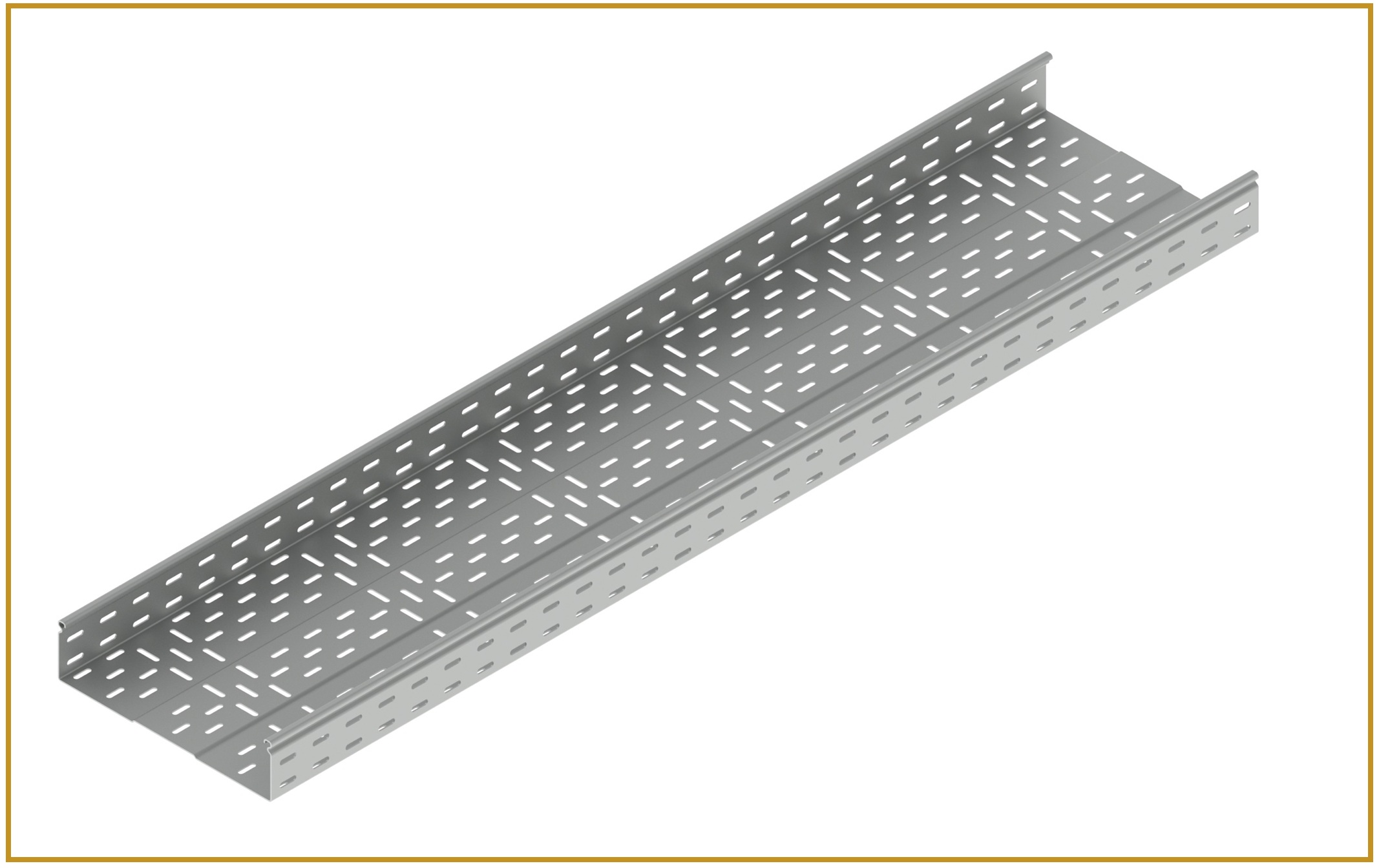
What is Perforated Cable Tray?
A perforated cable tray is designed to support and organize electrical cables while allowing airflow through its perforated structure. It provides a practical solution for cable routing, helping dissipate heat and allowing convenient access for installation, inspection, and maintenance. Perforated cable trays are suitable for a wide range of industrial, commercial, and electrical applications where effective cable management and ventilation are required.
Perforated Cable Tray Fittings, Dimensions & Materials
Straight Section
Standard Dimensions
Length (L): 2,500mm & 3,000mm
Depth (D): 50mm, 75mm, 85mm, 100mm, 150mm
Width (W): 100mm, 150mm, 200mm, 300mm, 450mm, 600mm, 700mm
Sheet Metal Thickness:
1.2mm for light loads (LL)
1.5mm for medium loads (M)
2.0mm for heavy loads (H)
Material
Material: Prime quality G.I. & M.S. sheets.
Finish (after fabrication):
Electro powder coating (E)
Pre-galvanised (P)
Hot dip galvanized (H)
Designs other than those listed above can be manufactured to meet special requirements.

Horizontal Cross
Standard Dimensions
Radius (R): 300mm
Width (W): 100, 150, 300, 450, 600, 750mm
Length (L): 900, 950, 1100, 1250, 1400, 1550mm
Breadth (B): 500, 550, 700, 850, 1000, 1150mm
Horizontal Tee
Standard Dimensions
Radius (R): 300mm
Width (W): 100, 150, 300, 450, 600, 750mm
Length (L): 900, 950, 1100, 1250, 1400, 1550mm
For other dimensions please Contact Us


Vertical Tee
Standard Dimensions
Radius (R): 300mm
Width (W): 100, 150, 300, 450, 600, 750mm
Length (L): 900, 950, 1100, 1250, 1400, 1550mm
Breadth (B): 500, 550, 700, 850, 1000, 1150mm
For other dimensions please Contact Us
Horizontal Elbow
Standard Dimensions
Radius (R): 300mm
Width (W): 100, 150, 300, 450, 600, 750mm
Length (L): 900, 950, 1100, 1250, 1400, 1550mm
Breadth (B): 500, 550, 700, 850, 1000, 1150mm
For other dimensions please Contact Us


Reducer
Left Hand Reducer
Right Hand Reducer
BNY offers a complete range of perforated bottom reducers for joining any two sizes of straight sections. Please specify both starting and ending widths.
Risers
Inside & Outside Vertical Risers
Standard Dimensions
Bend Angle: 90°
For other dimensions please
Contact
Us

Features of Perforated Cable Tray
perforated cable tray are designed to provide efficient cable management systems and cable support solutions for industrial, commercial, infrastructure, and electrical projects. Their evenly spaced perforations improve airflow around cables, helping reduce heat buildup while allowing convenient cable installation, inspection, and maintenance.
- Improved Ventilation: The evenly spaced perforations allow air to circulate around cables, helping dissipate heat and support reliable cable performance in electrical installations.
- Strong and Durable Construction: Manufactured using materials such as mild steel (MS), pre-galvanized steel, hot-dip galvanized steel, stainless steel, and aluminium to meet different load and installation requirements.
- Corrosion Resistance: Available with protective finishes such as pre-galvanizing, hot-dip galvanizing, and powder coating to improve durability in different operating environments.
- Easy Cable Installation: The open, perforated design allows convenient cable laying, routing, inspection, and maintenance, simplifying electrical installation work.
- Reliable Cable Support: Provides organized support for power cables, control cables, instrumentation cables, and communication wiring across industrial and commercial facilities.
- Flexible Installation Options: Suitable for horizontal and vertical cable routing in factories, commercial buildings, electrical rooms, warehouses, and infrastructure projects.
- Multiple Sizes and Specifications: Available in different widths, side heights, thicknesses, and lengths to accommodate varying cable quantities, load requirements, and project layouts.
- Easy Inspection and Maintenance: The perforated structure provides convenient access to cables, making routine inspection, troubleshooting, and cable replacement easier.
- Compatible Accessories: Can be installed with bends, tees, reducers, couplers, covers, and other cable tray accessories to create an organized cable routing system.
- Wide Range of Applications: Ideal for manufacturing plants, power distribution systems, commercial buildings, data centres, warehouses, and industrial electrical installations requiring effective cable management.
Benefits of Using Perforated Cable Tray
Using perforated cable tray offers an efficient way to organize, support, and maintain electrical cables across industrial and commercial installations. Their ventilated design, durable construction, and easy accessibility make them a practical choice for reliable cable management systems.
- Better Heat Dissipation: The perforated base and sides promote airflow around cables, helping reduce heat buildup and support efficient cable operation.
- Organized Cable Management: Keeps power cables, control cables, and instrumentation wiring neatly arranged, reducing cable clutter and improving installation quality.
- Reduced Maintenance Effort: The open design makes cable inspection, fault identification, cleaning, and replacement easier, helping simplify routine maintenance.
- Faster Installation: Provides convenient access for cable laying and routing, helping simplify installation and future modifications.
- Long-Term Durability: Available in galvanized steel, stainless steel, aluminium, and other suitable materials to meet different environmental and service requirements.
- Flexible Cable Routing: Can be configured with compatible bends, tees, reducers, and couplers to accommodate different layouts and installation requirements.
- Improved Cable Accessibility: Allows technicians to inspect cable conditions and access wiring more conveniently during troubleshooting and maintenance work.
- Cost-Effective Cable Support: Offers a practical cable routing solution that can simplify installation, inspection, and maintenance over the service life of the system.
- Suitable for Diverse Applications: Ideal for factories, commercial buildings, warehouses, power distribution systems, and infrastructure projects requiring organized cable support.
- Adaptable to Project Requirements: Available in different widths, heights, thicknesses, materials, and finishes to suit cable loads, installation conditions, and project specifications.
Applications of Perforated Cable Tray
perforated cable tray are widely used in industrial, commercial, and infrastructure projects to support and organize electrical cables. Their ventilated design, easy cable accessibility, and flexible installation make them suitable for various cable routing requirements.
- Manufacturing Industries: Used in factories and production units to route power cables, control wiring, and instrumentation cables for machinery and production equipment.
- Commercial Buildings: Suitable for offices, shopping malls, hotels, and business complexes to organize electrical wiring across ceilings, service corridors, and utility areas.
- Power Plants and Electrical Substations: Used to support and route electrical, control, and monitoring cables in power generation and distribution facilities.
- Data Centres and IT Facilities: Helps organize power and communication cables in equipment rooms and technical areas, subject to cable loading and installation requirements.
- Warehouses and Logistics Facilities: Provides organized cable routing for lighting systems, electrical panels, conveyor equipment, and material-handling machinery.
- Pharmaceutical and Food Processing Plants: Used for routing electrical and control cables in production areas where suitable materials and finishes are selected for the operating environment.
- Water and Wastewater Treatment Plants: Supports cables connected to pumps, motors, control panels, sensors, and monitoring equipment in water treatment facilities.
- Infrastructure Projects: Suitable for airports, railway facilities, metro stations, and other infrastructure installations requiring organized electrical cable support.
- HVAC and Building Services: Used to route control and power cables for air-conditioning systems, ventilation equipment, and building management systems.
- Industrial Utility Areas: Helps manage electrical wiring in workshops, plant rooms, equipment rooms, and service areas where cable inspection and maintenance are important.