

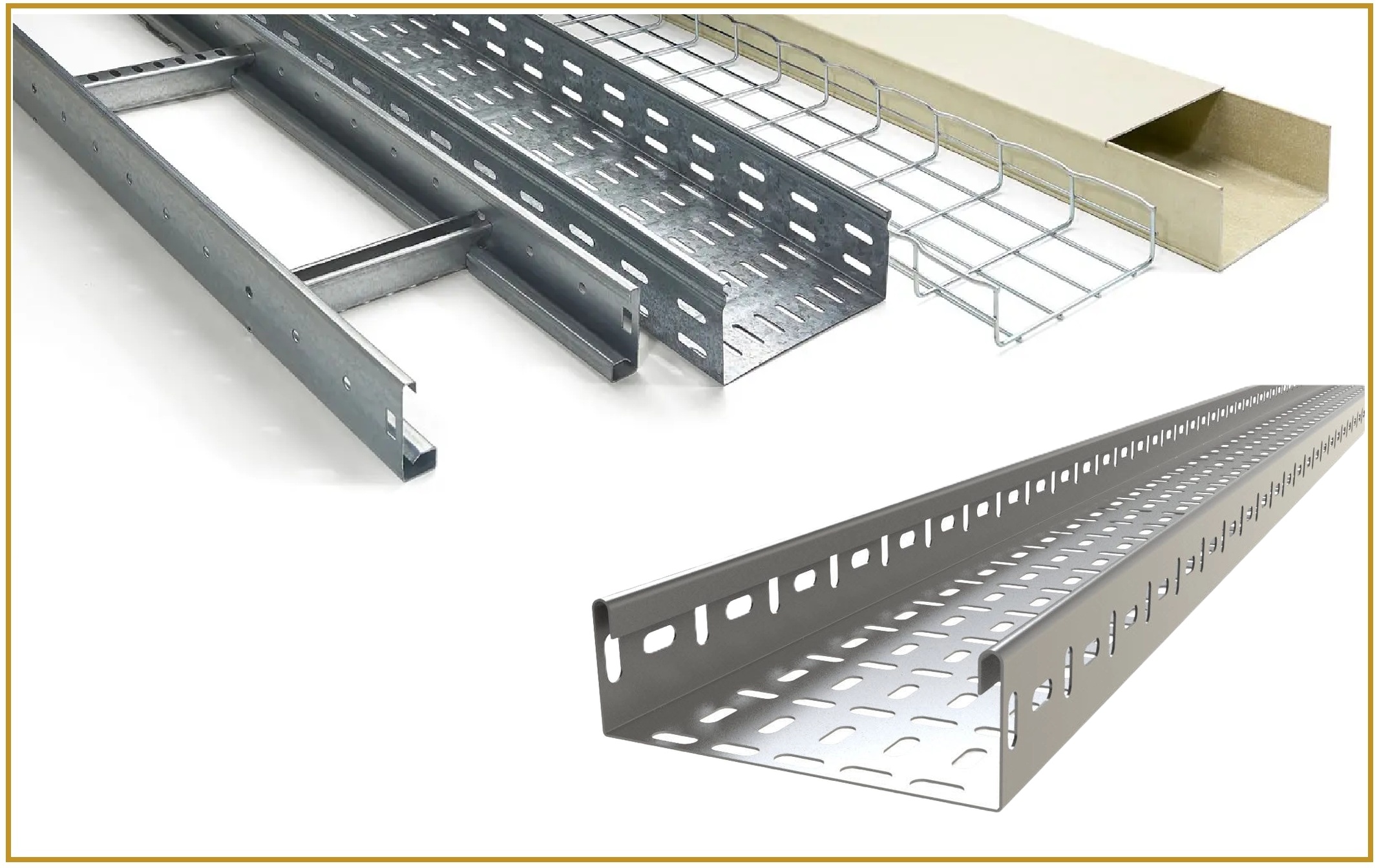
Choosing the right cable tray material is essential for safe cable management, long-term durability, and cost-effective electrical installations. Whether you are planning an industrial facility, commercial building, manufacturing plant, or outdoor infrastructure project, the cable tray material must match the site's environmental conditions and operational requirements.
Among the most commonly considered options are Galvanized Iron (GI) cable trays, Hot-Dip Galvanized (HDG) cable trays, and Stainless Steel (SS) cable trays. Each offers different levels of corrosion resistance, durability, maintenance requirements, and initial cost.
Understanding GI vs HDG cable tray differences can help electrical contractors, project engineers, and procurement teams make informed decisions. This guide compares all three options to help you identify the most suitable cable tray for your site.
In This Guide
1. What Is a GI Cable Tray?
A GI cable tray is generally manufactured from steel with a protective zinc coating. In many Indian project specifications, GI cable trays refer to trays made from pre-galvanized steel sheets, although the exact meaning should be confirmed in the product specification.
The zinc coating helps protect the underlying steel from corrosion, making GI cable trays suitable for many indoor electrical installations.
Key Benefits of GI Cable Trays
- Cost-effective solution: Often economical for standard indoor installations.
- Corrosion protection: Provides protection against rust in suitable environments.
- Easy installation: Available in different widths, depths, and configurations.
- Versatile applications: Suitable for commercial buildings, offices, electrical rooms, and indoor industrial facilities.
Where Should You Use GI Cable Trays?
GI cable trays are a practical option for dry indoor environments where exposure to rain, persistent moisture, chemicals, or corrosive vapours is limited. They can support power, control, instrumentation, and communication cables when appropriately designed for the cable load.
However, cut edges, drilled holes, and fabricated areas may have less corrosion protection than the original coated surface. For demanding outdoor environments, a more robust protective finish may be necessary.
Explore GI Cable Trays to understand the available options for your installation.
2. What Is an HDG Cable Tray?
A Hot-Dip Galvanized (HDG) cable tray is typically manufactured from steel and hot-dip galvanized after fabrication. The finished component receives a zinc coating that protects the steel against corrosion.
Because galvanizing can cover accessible surfaces, edges, and fabricated areas, HDG cable trays are often preferred for outdoor installations and locations exposed to higher humidity or more demanding environmental conditions. The actual protection depends on coating quality, thickness, fabrication, and exposure conditions.
Key Benefits of HDG Cable Trays
- Enhanced corrosion resistance: Well suited to many outdoor and industrial applications.
- Protection after fabrication: Galvanizing after fabrication can protect accessible cut edges and drilled areas.
- Long-term durability: Can reduce the frequency of corrosion-related maintenance when correctly specified.
- Broad application range: Suitable for infrastructure, industrial plants, power facilities, and outdoor cable routes.
Where Should You Use HDG Cable Trays?
HDG cable trays are commonly used on rooftops, outdoor utility corridors, solar power installations, industrial premises, and sites exposed to rain or humidity.
They are also worth considering in demanding environments where a standard pre-galvanized finish may not provide the required service life. However, aggressive chemical exposure, marine conditions, or highly corrosive atmospheres require a more detailed material assessment.
Learn more about Hot-Dip Galvanized Cable Trays for projects requiring enhanced corrosion protection.
3. What Is a Stainless Steel Cable Tray?
Stainless steel cable trays are manufactured using corrosion-resistant stainless steel grades, commonly SS304 or SS316, depending on the application.
Unlike GI and HDG systems, stainless steel relies on its alloy composition and passive surface layer for corrosion resistance rather than a zinc coating. The appropriate grade is particularly important when the tray will be exposed to moisture, cleaning chemicals, salts, or industrial contaminants.
Key Benefits of Stainless Steel Cable Trays
- Strong corrosion resistance: Offers excellent performance when the grade matches the environment.
- No zinc coating required: Corrosion resistance comes from the stainless steel itself.
- Hygienic applications: Suitable for facilities where cleanability and surface condition are important.
- Long service potential: Can provide reliable performance in appropriately selected environments.
Where Should You Use Stainless Steel Cable Trays?
Stainless steel cable trays are commonly considered for pharmaceutical facilities, food-processing plants, chemical industries, marine installations, and selected wastewater-treatment applications.
SS304 may be suitable for many general industrial and hygienic environments. SS316 generally provides improved resistance to chloride-related corrosion because of its molybdenum content, making it a candidate for certain coastal and chemical applications.
However, no stainless steel grade is universally corrosion-proof. Chloride concentration, temperature, chemical exposure, crevices, and cleaning procedures can all affect performance.
Explore Stainless Steel Cable Trays to discuss suitable material options for your project.
4. GI vs HDG vs Stainless Steel Cable Trays: Key Differences
Although all three materials support organised cable routing, their corrosion protection mechanisms and ideal applications differ.
| Comparison factor | GI cable tray | HDG cable tray | Stainless steel cable tray |
|---|---|---|---|
| Protective mechanism | Zinc coating, commonly applied before fabrication | Hot-dip zinc coating, commonly applied after fabrication | Corrosion-resistant stainless steel alloy |
| Initial cost | Generally lower | Generally moderate | Generally higher |
| Indoor suitability | Very good in suitable conditions | Very good | Very good |
| Outdoor suitability | Depends on exposure and coating | Often a strong option | Depends on grade and environment |
| Corrosion resistance | Suitable for mild environments | Enhanced protection in many outdoor environments | High when the grade is correctly selected |
| Maintenance | Depends on coating condition | Depends on coating condition and exposure | Depends on grade, contamination, and cleaning |
| Typical applications | Offices and indoor electrical rooms | Rooftops, outdoor routes, and industrial sites | Pharmaceutical, food-processing, and selected chemical facilities |
5. How to Choose the Right Cable Tray for Your Site
The best cable tray is not necessarily the most expensive one. It is the option that meets your technical requirements while delivering suitable durability and lifecycle value.
Consider the Installation Environment
Start by identifying whether the cable route is indoors, outdoors, near the coast, or within a chemically aggressive facility.
- For dry indoor environments, GI may be sufficient.
- For outdoor installations exposed to rain and humidity, HDG is often worth considering.
- For hygienic facilities or selected corrosive environments, stainless steel may be more appropriate.
Evaluate Cable Load and Support Requirements
Material selection is only one part of cable tray design. Cable weight, tray width, side height, sheet thickness, support spacing, fittings, and installation conditions all affect performance.
Choose a tray configuration with a declared safe working load appropriate for the project. Do not assume that a heavier-looking tray automatically provides adequate load capacity.
Compare Initial Cost with Lifecycle Cost
GI cable trays may offer a lower initial purchase price for indoor installations. HDG can provide better value where stronger corrosion protection helps reduce maintenance and replacement needs. Stainless steel may justify its higher upfront cost when environmental conditions demand its corrosion resistance.
Compare the expected service life, maintenance requirements, replacement costs, and consequences of cable-route failure before making a final decision.
Check Project Specifications and Standards
Confirm the required material grade, coating specification, dimensions, accessories, and applicable standards before placing an order. Also check compatibility between the tray, fasteners, supports, and other metals in the installation.
6. Common Applications: Which Material Fits Best?
Different sites have different priorities, so the selection should reflect actual operating conditions.
- Commercial buildings and offices: GI is often a practical choice for indoor cable routing.
- Manufacturing plants: GI or HDG may suit general areas, while corrosive process zones may require stainless steel or another specialised material.
- Solar power projects: HDG is frequently considered for outdoor cable routes exposed to weather.
- Pharmaceutical and food-processing facilities: Stainless steel may be preferred where cleanability and chemical exposure are important.
- Coastal and marine facilities: HDG or stainless steel may be suitable depending on chloride exposure, grade, coating, and maintenance requirements.
For every application, assess the environmental conditions and engineering requirements rather than relying on the industry name alone.
7. Why Choose BNY Metalcoat for Cable Tray Solutions?
BNY Metalcoat Pvt. Ltd. manufactures and supplies cable management solutions for industrial, commercial, infrastructure, and other electrical projects. Its product range includes perforated cable trays, ladder cable trays, wire mesh trays, GI cable trays, hot-dip galvanized cable trays, and stainless steel options.
The company offers cable tray solutions in different sizes and configurations, with customised options based on project requirements. Selecting the right system involves reviewing cable loads, routing layouts, installation conditions, surface finishes, and required accessories.
Whether you need an economical indoor solution or a cable tray system designed for more demanding environmental conditions, sharing your bill of quantities (BOQ), cable schedule, or project drawings can help establish the appropriate specifications.
Visit BNY Metalcoat to explore its cable tray range and discuss your project requirements.
Conclusion
Selecting between GI, HDG, and stainless steel cable trays depends on the installation environment, corrosion exposure, budget, maintenance expectations, and engineering specifications.
GI cable trays are often suitable for controlled indoor environments. HDG cable trays are a strong option for many outdoor and industrial applications requiring enhanced corrosion protection. Stainless steel cable trays are worth considering for hygienic facilities and environments where the correct stainless steel grade offers the necessary corrosion resistance.
Ultimately, the right choice balances performance, safety, and lifecycle cost. By understanding the GI vs HDG cable tray differences and evaluating stainless steel alternatives, project teams can choose a cable management system that meets the site's requirements.
Need help selecting a cable tray for your project? Contact BNY Metalcoat with your BOQ, cable schedule, or technical specifications to discuss suitable materials, dimensions, finishes, and configurations.
Frequently Asked Questions
GI cable trays commonly use pre-galvanized steel, while HDG cable trays are generally galvanized after fabrication. HDG provides additional protection to accessible edges and fabricated areas, making it suitable for many outdoor applications.
HDG cable trays are generally preferred for outdoor installations exposed to rain, moisture, and humidity. Their corrosion protection can offer better durability than standard pre-galvanized cable trays.
Stainless steel cable trays can offer better corrosion resistance in demanding or chemically aggressive environments. HDG is often a more economical option for general outdoor and industrial applications.
GI cable trays are generally economical for indoor installations with limited exposure to moisture. HDG and stainless steel may provide better long-term value in environments requiring greater corrosion resistance.
GI cable trays are suitable for offices, commercial buildings, warehouses, and indoor electrical rooms. They are ideal for environments where exposure to moisture and corrosive substances is limited.
SS304 is suitable for many general industrial and indoor applications requiring corrosion resistance. SS316 offers improved resistance to chloride corrosion, making it suitable for certain coastal and chemical environments.
Consider the installation environment, cable load, corrosion exposure, material thickness, and maintenance requirements. Also evaluate the project budget, applicable standards, and expected service life before selecting a cable tray.
Choose GI for suitable indoor environments, HDG for many outdoor installations, and stainless steel for demanding applications requiring appropriate corrosion resistance. The final choice should depend on site conditions, project specifications, durability requirements, and lifecycle cost.
Share your BOQ or site conditions for a project-specific recommendation
Call +91 7020753022 / +91 9067686956 or email bnymetalcoat@gmail.com
Request a Cable Tray Quote